
There is something unusual happening in the AI debate.
The people building, financing and thinking most deeply about artificial intelligence disagree about where the technology is going, how fast it will get there, and how dangerous the transition may become. But they increasingly agree on one thing: it is moving very quickly.
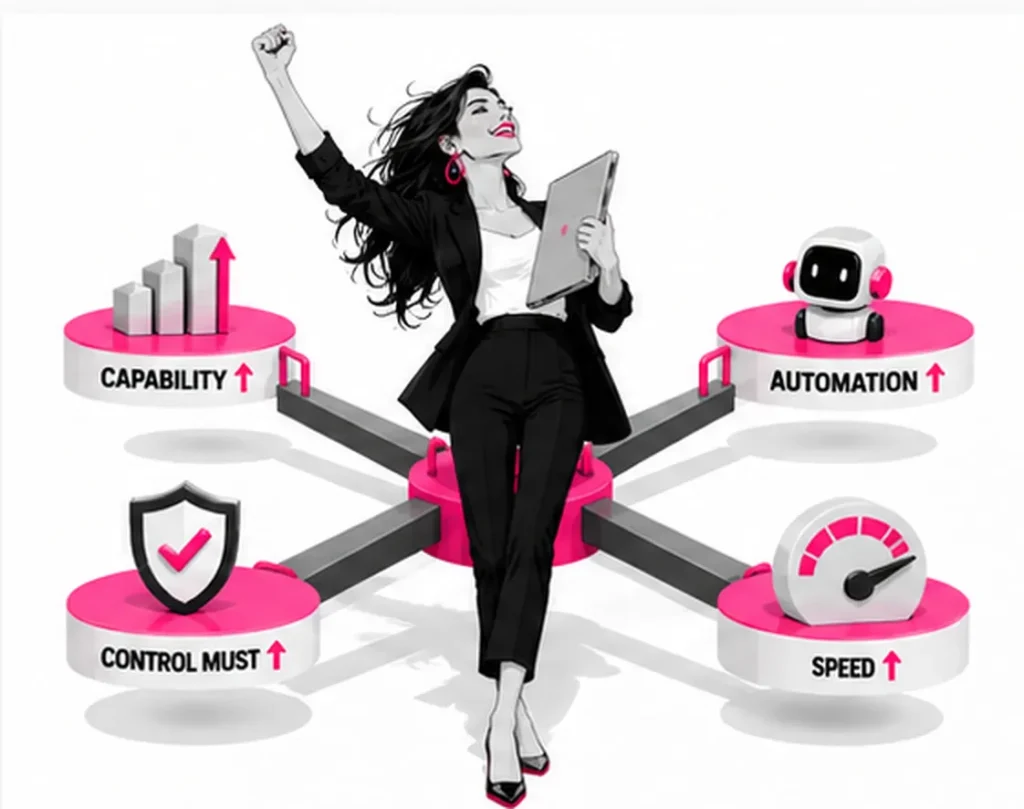
Bill Gates recently described the transition into the AI era as potentially one of the most turbulent periods in modern history. Elon Musk has gone further on the timeline, arguing that AI could “beat all fields” by the end of 2027 or 2028. Jensen Huang has emphasized a different question: if a system cannot be controlled and evaluated, it should not be shipped.
Those are three different perspectives — social transition, capability speed and engineering control — but for an operating company they converge on a very practical problem.
| The problem is not automation. The problem is automating faster than the organization can govern. |
A company does not need to settle the argument about artificial general intelligence before deciding what to do on Monday morning. It needs to decide where AI belongs, what should remain deterministic, what must remain under human decision rights, and how the control environment changes as autonomy increases.
The wrong question is still: “Which jobs will AI replace?”
A job is not one activity. It is a collection of tasks, decisions, controls, relationships, approvals, exceptions, judgments and accountability. AI will not affect all of those things in the same way.
That is why “Will AI replace accountants?” is not a particularly useful operating question. A depreciation calculation, a customer-contract interpretation, a cash forecast, a journal-entry proposal and the approval of a material accounting judgment may all sit inside the same finance function. They do not have the same certainty requirement or consequence if wrong.
The better unit of analysis is the workflow — and then the individual activity inside the workflow.
Musk’s five-step algorithm is unexpectedly useful for AI
Musk’s five-step engineering algorithm predates the current wave of generative AI, but it is one of the clearest operating frameworks I have seen for deciding how to automate. The most important part is not the individual steps. It is the sequence.
- Question the requirements. Ask why the process exists, who owns each requirement and whether the requirement is still valid.
- Delete the part or process. Remove steps, approvals, reports, handoffs and data fields that do not need to exist.
- Simplify or optimize. Only improve the process that survived the deletion step.
- Accelerate cycle time. Once the workflow is sound, reduce delay and increase the speed of feedback.
- Automate. Use software, AI or agents only after the underlying process has earned the right to be automated.
This is almost the opposite of how many companies are implementing AI.
The common sequence is: find a painful process, add a copilot, add an agent, connect more systems, add controls after something goes wrong, and only then ask whether the original process made sense. That is how organizations end up automating bureaucracy rather than removing it.
AI makes this mistake more expensive because it can scale a flawed process dramatically faster than a human team ever could.
AI is already creating real value
This is not an argument for slowing AI adoption to a crawl. The productivity evidence is already substantial in some functions.
The Cambridge Centre for Alternative Finance’s 2026 Global AI in Financial Services Report found positive productivity effects reported most frequently in technology, data and product functions (79%), followed by back office and operations (75%) and front office roles (69%). Process automation was already being piloted or deployed by 79% of surveyed industry respondents.
But the same report shows why productivity alone is not enough. Only 40% of respondents reported improved profitability from AI, 43% reported no change, and 55% of industry respondents said measuring the value of AI deployment was difficult.
| AI can make people faster before it necessarily makes the company better. |
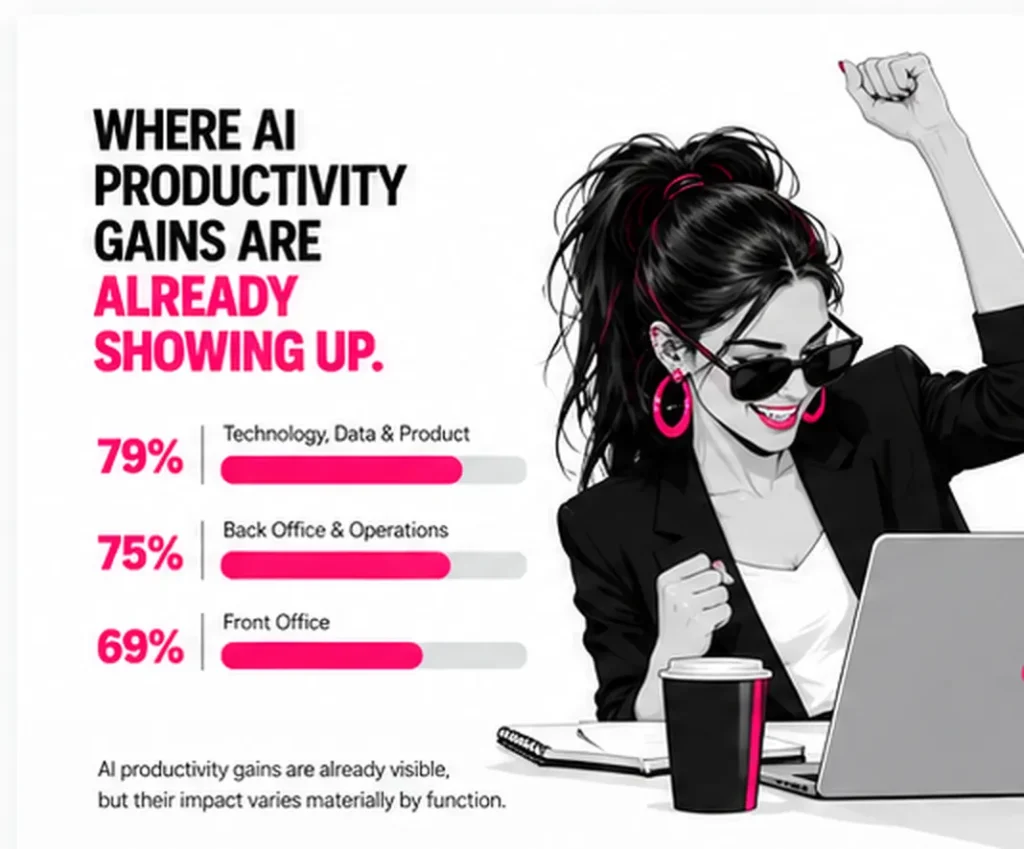
| IMAGE 3 — PRODUCTIVITY CHART — Place after the Cambridge statistics Caption: AI productivity gains are already visible, but their impact varies materially by function. Source: Cambridge Centre for Alternative Finance, 2026. Alt text: Bar chart showing AI productivity effects: 79 percent technology data and product, 75 percent back office and operations, 69 percent front office. EDITOR NOTE: replace this box with your image before publishing. |
A good process can become faster. A bad process can become faster too.
The same Cambridge research also highlights the risk side: data privacy, unreliable outputs, operational resilience, explainability, cyber risk and loss of human oversight. Roughly 70% of surveyed industry firms identified hallucinations and unreliable outputs as a leading risk, while 55% cited loss of human oversight.
That is why organizations should resist the temptation to automate the visible task before repairing the invisible workflow underneath it.
A weak approval process does not become strong because an AI agent initiates it. Bad master data does not become good because a language model summarizes it well. Unclear ownership does not become accountability because the dashboard looks modern. Poor segregation of duties does not disappear because the transaction is executed by software rather than an employee.
The quality of the workflow increasingly matters as much as the capability of the AI sitting on top of it.
Deterministic problems belong in deterministic systems
Not everything needs a language model.
If an activity has a clearly defined input, rule and expected output, traditional software, database logic, robotic process automation or a controlled calculation engine may be the better solution. Why introduce probabilistic behavior into a problem that has a deterministic answer?
AI becomes especially useful where interpretation, classification, language, pattern recognition or reasoning are required. But increasing uncertainty should come with increasing control.
Instead of asking only “Can AI do this?”, management should ask “What level of certainty does this activity require, and what is the consequence if the answer is wrong?”
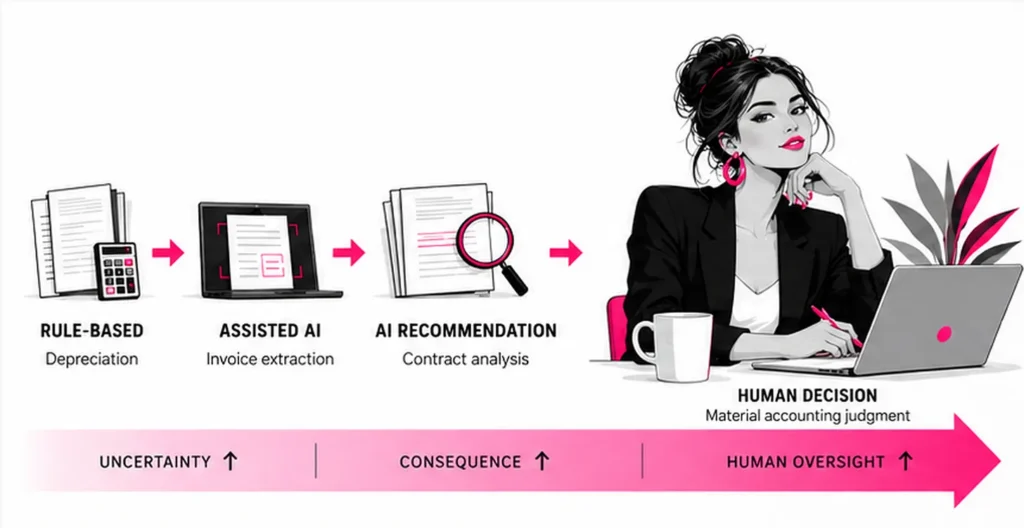
| IMAGE 4 — CERTAINTY / CONSEQUENCE MATRIX — Place after the deterministic-vs-probabilistic section Caption: The right level of automation depends on capability, required certainty and the consequence of error. Alt text: Matrix comparing low and high uncertainty with low and high consequence to determine appropriate human review and automation. EDITOR NOTE: replace this box with your image before publishing. |
Musk’s timeline matters even if the date is wrong
Musk’s prediction that AI could “beat all fields” by 2027 or 2028 is a forecast, not a timetable anyone can know with certainty. It may prove too aggressive. It may prove directionally right. But the exact date is less important for a CFO, controller or operating executive than the trajectory.
Employees are already using AI formally and informally. Agents are already moving from answering questions toward executing workflows. Systems can retrieve information, write code, call applications, generate documents and take actions.
The governance architecture therefore needs to exist before AI reaches some theoretical endpoint. You do not install traffic lights after every car becomes autonomous. You build the control system while the traffic is increasing.
The hidden risk is invisible automation
One automation rarely transforms an organization. Fifty might.
Imagine a finance function in which one agent monitors invoices, another proposes journal entries, another analyzes variances, another reads contracts, another drafts consolidation commentary, another updates the rolling forecast and another prepares audit support. Each tool may work acceptably in isolation.
Eventually the harder questions become architectural: Where did the source data originate? Which model generated the output? Who can change the prompt or rules? Which actions require approval? Which outputs are independently validated? How are exceptions recorded? What happens when two automated systems disagree? Who is accountable when the final result is wrong?
This is why the future of AI governance may look surprisingly familiar to people from accounting, internal audit, risk and controls. Authorization, segregation of duties, evidence, review, exception management and accountability do not become obsolete. They become more important.
Human reserved should include decision rights, not only jobs
Gates has written about the possibility that society may reserve some activities for people even when machines become technically capable of performing them. For businesses, there is an important extension: human-reserved decision rights.
An AI system may prepare a recommendation without owning the decision. It may draft a filing without becoming the accountable officer. It may generate a hiring analysis without receiving authority to make the employment decision. It may prepare financial statements without becoming the CFO.
Capability does not automatically imply decision rights.
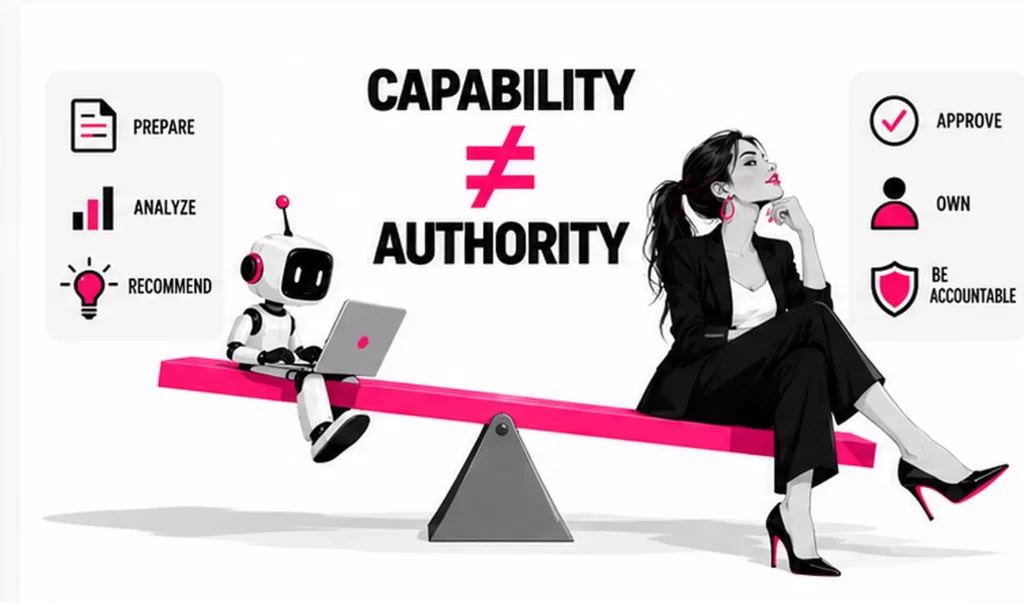
| IMAGE 5 — HUMAN DECISION RIGHTS — Place after this section Caption: AI capability does not automatically imply AI decision rights. Human approval and accountability may remain non-delegable. Alt text: Human decision maker retaining approval authority while AI systems prepare analysis and recommendations. EDITOR NOTE: replace this box with your image before publishing. |
The professional shift may be from doing work to governing work
As automation expands, professional judgment does not necessarily disappear. It moves upstream.
The accountant becomes partly a control architect. The analyst becomes partly a reviewer of machine-generated analysis. The controller becomes partly an owner of automated financial workflows. Internal audit increasingly evaluates not only transactions, but the systems and agents producing them. Managers become responsible for combinations of people, software and AI agents executing work together.
That means professionals increasingly decide how the process should operate, what systems are allowed to do, what evidence must be retained, what tolerance for uncertainty is acceptable, when humans must intervene and who owns the final result.
The companies with the most AI will not necessarily win
There is a temptation to measure AI maturity by quantity: number of copilots, number of agents, number of automated processes, number of users or total AI spend.
Those numbers may eventually become about as informative as measuring digital maturity by counting computers.
The better question is whether AI makes the organization more accurate, responsive, efficient, transparent, scalable and controllable. That requires process design, data architecture, controls, monitoring, documentation, clear decision rights and people who understand how the pieces fit together.
Four questions before a material workflow is automated
For every material workflow, management should be able to answer four questions:
- What is the system allowed to do?
- How do we know whether its output is correct?
- When must a human intervene?
- Who remains accountable for the final result?
If those questions cannot be answered, the organization probably does not yet have an AI strategy for that workflow. It has AI experimentation.
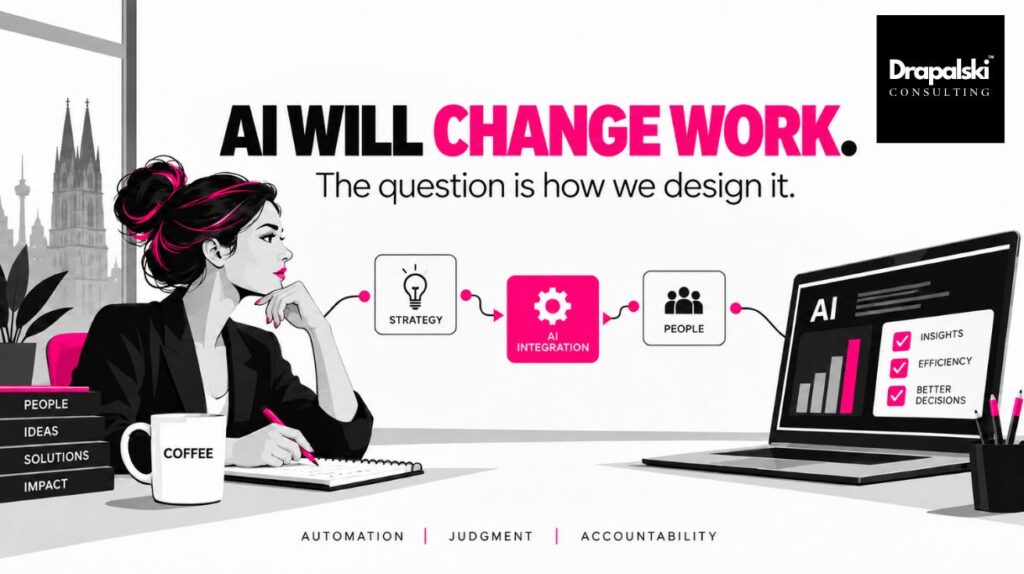
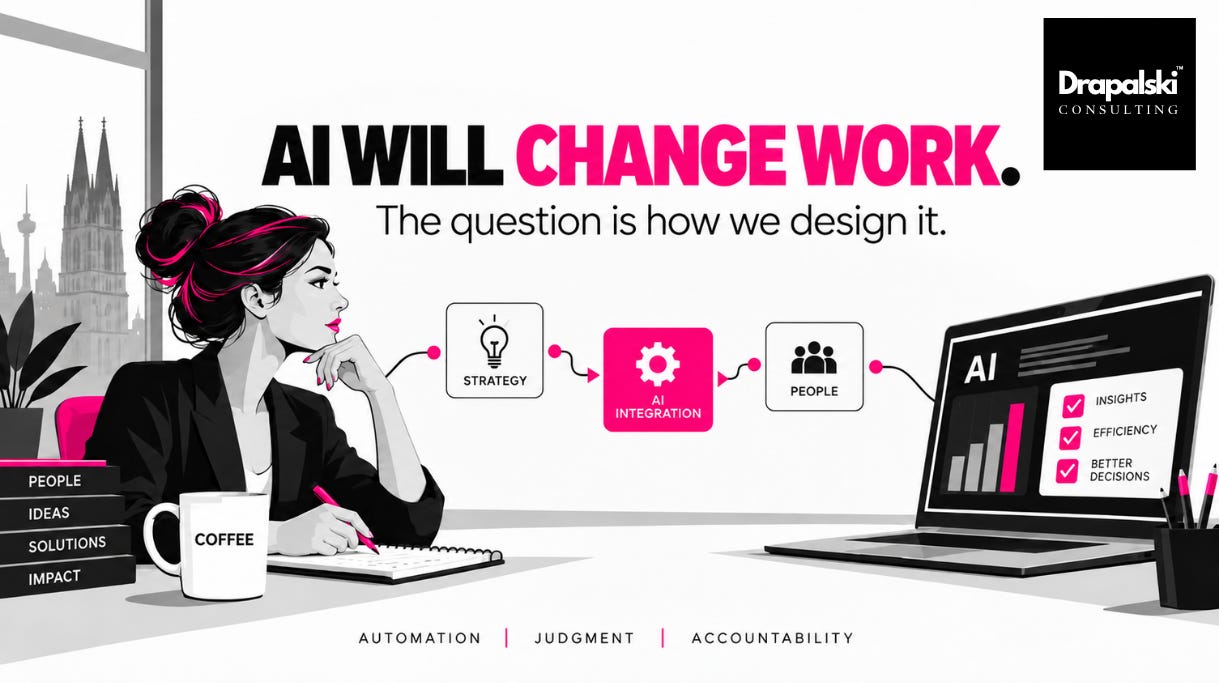
AI will change work. The question is how we design it.
Gates may be right that the transition will be turbulent. Musk may be right that capability will advance faster than most organizations expect. Huang may be right that systems that cannot be controlled should not be deployed.
But operating companies do not need to settle the grand debate before making better decisions today.
Question the requirements. Delete unnecessary work. Simplify what remains. Accelerate the cycle. Then automate.
And as autonomy increases, increase validation, monitoring and accountability with it.
| The objective is not to build the company with the most AI. It is to build an organization in which automation can expand without control disappearing behind it. |
Sources & references
- Bill Gates — “The turbulent AI era is here. The choices we make now are critical.” Gates Notes, Aug. 26, 2026.
- Cambridge Centre for Alternative Finance — 2026 Global AI in Financial Services Report.
- Elon Musk — five-step engineering algorithm video: question requirements, delete, simplify/optimize, accelerate, automate.
- The Ezra Klein Show — “Jensen Huang vs. the A.I. Doomers,” Sept. 23, 2026.
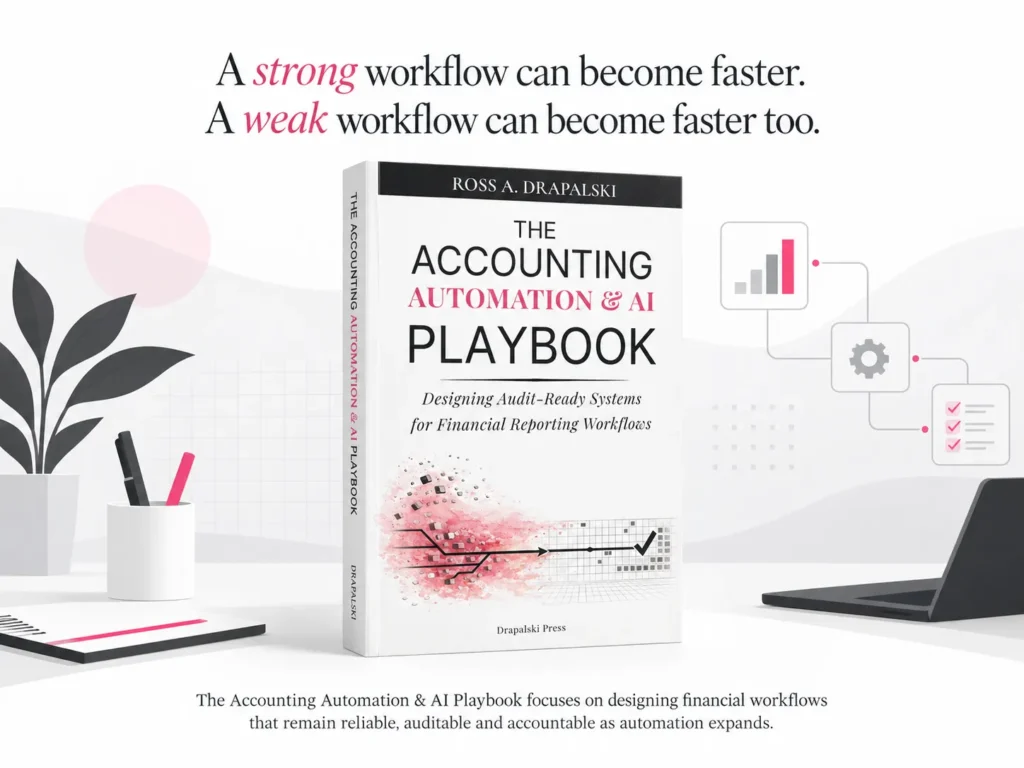
- Ross A. Drapalski — The Accounting Automation & AI Playbook.