

A Transatlantic Governance Architecture (Transnationale Vermögens-Governance-Struktur)
1. The Jurisdictional Fragmentation Problem (Zersplitterung der Zuständigkeiten)
When a U.S. person relocates to Germany or the broader EU, the economic reality rarely migrates in parallel with the legal reality. The individual becomes resident in one regulatory ecosystem while their capital stack remains embedded in another. The result is not merely tax complexity — it is governance dislocation.
The modern globally mobile wealth holder lives inside overlapping regimes:
- U.S. citizenship-based taxation (Welteinkommensprinzip – US version)
- German residency taxation (Wohnsitzprinzip)
- EU reporting regimes (DAC6, CRS-Umfeld)
- Institutional reporting layers (custodians, brokers, trustees)
The family office emerges not as a prestige structure but as a coordination protocol — effectively a meta-institution managing competing legal ontologies.
Core structural tension:
the operating reality of capital becomes network-based while regulation remains jurisdiction-based.
Observable consequences
- The trust (US trust) functions as legal ownership
- The GmbH (EU operating entity) functions as operational ownership
- The individual functions as reporting nexus
Practical symptoms
- Double data reconciliation cycles
- Asynchronous valuation frameworks
- Conflicting fiduciary standards (Treuepflicht vs Fiduciary Duty)
2. The Family Office as Governance Middleware (Governance-Middleware zwischen Rechtssystemen)
Historically, family offices evolved once informal coordination became risk-bearing rather than efficiency-enhancing Single_Family_Offices_The_Art_o….
In the cross-border case, the office becomes something different: not wealth management — but governance infrastructure.
It functions as a translation layer between legal systems.
The family office organizes rights and obligations of owners beyond the operating business
Instead of managing investments, it manages interpretations.
Expanded functional model
A. Legal translation layer
- U.S. tax classification vs German legal classification
- Trust vs Stiftung vs direct ownership
- Beneficial owner vs wirtschaftlich Berechtigter
(tools: entity mapping workflows in reporting platforms — e.g., Addepar, Archway, or customized data warehouse)
B. Reporting harmonization layer
- GAAP ↔ HGB ↔ IFRS
- Tax basis vs commercial balance sheet
- Mark-to-market vs historical valuation
(software examples: reporting aggregation tools, portfolio consolidation engines)
C. Decision authority architecture
- Who is the economic decision maker?
- Who is the tax decision maker?
- Who is the reporting decision maker?
This separation rarely exists in single-country wealth structures but becomes mandatory internationally.
3. From Wealth Management to Institutionalization (Institutionalisierung des Privatvermögens)
Research consistently shows family offices mature into professional organizations once wealth complexity exceeds personal coordination capacity
Modern offices increasingly operate as standalone entities with formal governance
The cross-border U.S.–EU case accelerates this transformation earlier than asset size alone would require.
Why?
Because complexity scales faster than wealth.
A €10M entrepreneur moving internationally can require more governance infrastructure than a €100M domestic entrepreneur.
Maturity progression (Reifegradmodell)
Stage 1 — Advisory aggregation (Berater-Koordination)
- CPA
- Steuerberater
- Attorney
- Bank
Problem: advisory silos
Stage 2 — Central oversight (Zentralsteuerung)
- Shared data repository
- Unified reporting calendar
- Document authority matrix
Stage 3 — Institutional family office (Institutionelles Family Office)
- Internal governance rules
- Investment committee
- Policy-based decisions
- Defined escalation pathways
(Often supported by portfolio management systems and workflow engines)
4. The Governance Problem Is Human, Not Financial (Das Problem ist organisatorisch, nicht finanziell)
Family offices exist primarily to manage relationships, not assets.
Modern literature increasingly frames them as custodians of continuity rather than return generators
In cross-border families, conflicts arise not from risk tolerance but from interpretive authority:
| Question | Hidden issue |
|---|---|
| “Can we invest?” | legal classification |
| “Should we invest?” | family governance |
| “How do we report?” | jurisdictional compliance |
Governance domains
Operational governance (Unternehmensführung)
- Operating companies
- Board oversight
Owner governance (Gesellschafterebene)
- Distribution policy
- Liquidity events
Family governance (Familienordnung)
- Participation rules
- Next generation education
The family office operates primarily in the last two — which are structurally underdeveloped without it.
5. Investment Strategy Becomes Secondary to Coordination Strategy (Koordination vor Rendite)
Global family offices increasingly prioritize wealth preservation over activity
For internationally mobile U.S. persons, the first investment decision is not allocation — it is structure.
The hidden portfolio
The family portfolio has three layers:
Layer 1 — Economic assets
- securities
- companies
- real estate
Layer 2 — Legal wrappers
- trusts
- corporations
- partnerships
Layer 3 — Reporting identities
- taxpayer
- resident
- beneficial owner
The family office manages Layer 3 so Layer 1 remains usable.
6. Technology as Coordination Infrastructure (Technologie als Infrastruktur)
AI and data workflows are increasingly embedded into family office operations
Typical architecture
- document ingestion (OCR extraction)
- entity tagging
- transaction classification
- reporting routing
(example categories: reporting automation tools, reconciliation engines, internal knowledge base systems)
The purpose is not efficiency — it is interpretability.
7. Conclusion — The Cross-Border Family Office Is a Legal Operating System
For domestic families, a family office optimizes wealth.
For U.S. persons living in Europe, it stabilizes reality.
It provides:
- continuity across generations
- continuity across jurisdictions
- continuity across legal definitions
The structure therefore should not be viewed as a luxury service (Prestige-Dienstleistung) but as a governance operating system (Governance-Betriebssystem) required once identity and capital reside in different countries.
Tools & Resources
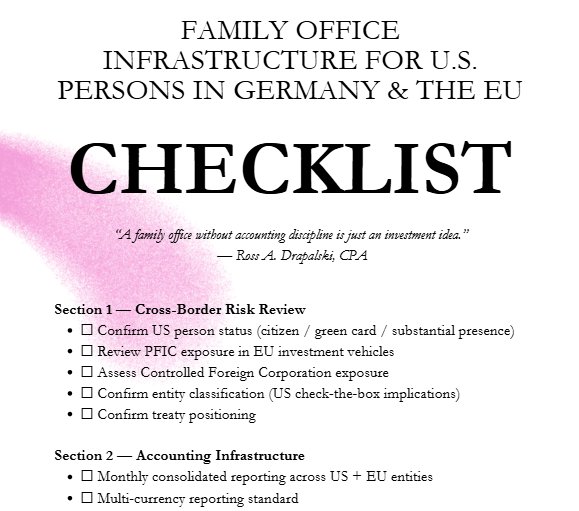
Family Office Infrastructure Checklist
“For US families living abroad, structure is not optional — it’s protection.”
— Ross A. Drapalski, CPA