
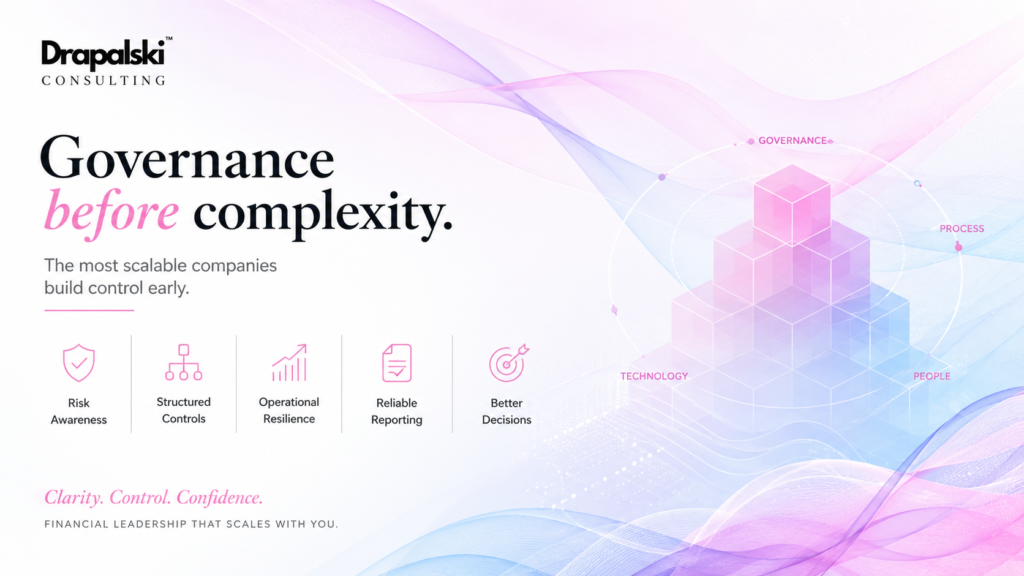
Over the last decade, startups optimized aggressively for speed.
Today’s scale-ups can launch globally using:
- API-first infrastructure
- embedded finance
- AI-enabled workflows
- no-code automation
- neo-banking platforms
- distributed SaaS ecosystems
Operational leverage has never been more accessible.
But operational control has not evolved at the same pace.
That gap is becoming one of the defining enterprise risks of modern scaling companies.
The Illusion of Operational Maturity
Many founders assume modern tooling automatically creates operational maturity.
It does not.
A company may operate using:
- Stripe Treasury or embedded finance rails
- Mercury, Relay, or alternative banking environments
- HubSpot, Attio, Airtable, or Notion-based operating systems
- Zapier, Make, or n8n automation layers
- AI agents and autonomous workflows
…and still maintain fundamentally weak internal controls.
The result is often hidden operational exposure across:
- segregation of duties failures
- incomplete audit trails
- weak access governance
- decentralized approval structures
- fragmented reporting environments
- inconsistent data ownership
- shadow finance processes
- compliance vulnerabilities
These risks rarely appear during early growth.
They emerge during scaling.
Especially once companies begin adding:
- investors
- lenders
- outsourced operators
- international entities
- institutional reporting requirements
Why Governance Is Moving Earlier
Historically, governance frameworks were associated with banks and large public companies.
That assumption is increasingly outdated.
Today, many of the same control principles are becoming relevant much earlier in the company lifecycle because infrastructure complexity has accelerated faster than operational maturity.
The strongest scale-ups begin implementing operational discipline before external pressure forces the issue.
This often includes elements of:
COSO Internal Control Framework
Used to structure internal controls, governance accountability, and reporting integrity.
SOX-Oriented Control Thinking
Focused on financial reporting reliability, process accountability, and control documentation.
Segregation of Duties (SoD)
Reducing operational concentration risk by separating conflicting responsibilities.
Role-Based Access Control (RBAC)
Ensuring system permissions align with operational responsibilities and governance expectations.
Maker-Checker Approval Workflows
Reducing fraud exposure and approval concentration through dual authorization structures.
Continuous Controls Monitoring (CCM)
Moving from reactive oversight toward ongoing operational monitoring.
Governance, Risk & Compliance (GRC) Structures
Creating scalable oversight across systems, reporting, and operational processes.
Modern Infrastructure Changes the Risk Profile
Traditional businesses centralized operations inside a limited number of systems.
Modern scale-ups distribute operations across dozens of interconnected platforms.
CRM systems connect to payment processors.
Banking systems connect to automation workflows.
AI tools connect directly into operational decision-making.
Third-party APIs continuously exchange financial and operational data.
This creates enormous operational leverage.
But it also creates:
- expanded attack surfaces
- fragmented accountability
- reduced process visibility
- increased dependency risk
- faster propagation of operational errors
- more complex governance requirements
The challenge is no longer simply “finance.”
The challenge is operational control inside decentralized digital environments.
Governance as a Scaling Advantage
The next generation of operational failures will likely not come from lack of growth.
They will come from uncontrolled complexity inside digitally fragmented businesses.
That is why governance is no longer a late-stage function.
Increasingly, investors, institutional customers, lenders, and strategic partners evaluate:
- reporting maturity
- operational resilience
- access governance
- internal controls
- audit readiness
- risk oversight capability
alongside revenue growth.
Because scalable businesses ultimately require:
- scalable controls
- scalable reporting
- scalable decision-making
- scalable accountability
Modern infrastructure creates speed.
Governance creates resilience.
The strongest scale-ups are not simply software-enabled.
They are governance-enabled.
Clarity. Control. Confidence.