
A Thought I’ve Been Having Lately
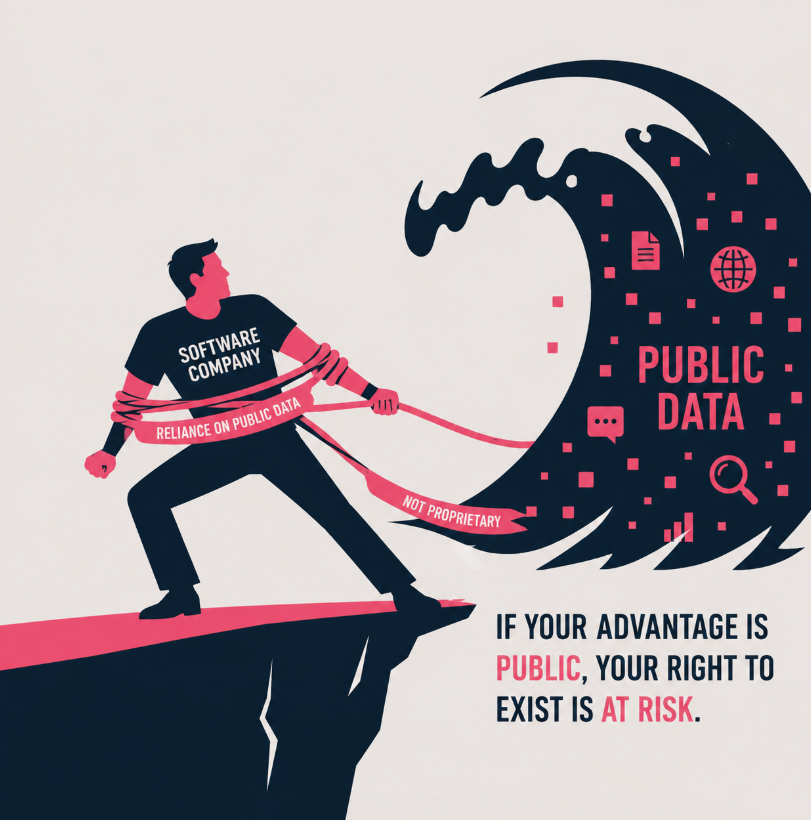
How many companies are quietly selling their future right to exist because their product is primarily built on public or non-proprietary data?
For decades, many software and information businesses created value by finding, organizing, summarizing, analyzing, or presenting information better than their customers could do themselves. That was a powerful business model because information was fragmented, difficult to access, and expensive to process.
Today, that assumption deserves to be challenged.
An AI agent equipped with a modern large language model (LLM), access to public information, and a structured workflow can increasingly replicate much of what many information businesses provide. In some cases, it can do so faster, cheaper, and at a level of quality that is “good enough” for most users.
This raises an uncomfortable question:
If your product is built primarily on information that everyone can access, what exactly is your moat?
The Commoditization of Intelligence
Historically, companies gained advantages through superior access to information.
Today, intelligence itself is becoming a utility.
Organizations can choose between multiple AI providers and optimize for cost, speed, accuracy, reasoning capability, security requirements, or industry specialization. The underlying technology is increasingly accessible, and the cost of deploying sophisticated information-processing capabilities continues to decline.
In practical terms, many businesses are discovering that tasks previously requiring expensive software subscriptions can now be performed through combinations of:
- AI agents
- Public data sources
- Workflow automation
- API integrations
- Human review and oversight
The result is that many products previously sold as standalone solutions are beginning to look more like features.
Which Companies Remain Defensible?
Not every business is at risk.
In fact, AI may strengthen the competitive position of some companies.
The organizations most likely to maintain durable advantages typically possess one or more of the following:
Proprietary Data
Data that competitors cannot easily access, replicate, or purchase.
Examples include operational data, transaction data, customer-specific data, machine-generated data, and years of accumulated institutional knowledge.
Embedded Workflows
Products deeply integrated into how work is performed.
When software becomes part of an organization’s operating model, replacement costs increase dramatically.
Customer Relationships and Trust
Many business decisions ultimately depend on trust, accountability, and expertise rather than pure information access.
Distribution Advantages
The best technology does not always win.
Often, the company with the strongest distribution network, ecosystem, or customer reach captures the greatest value.
Real-World Execution Capability
AI can recommend actions.
Organizations still need people, processes, governance, controls, and leadership to execute those actions effectively.
The Emerging Risk
The businesses that concern me most are those whose primary value proposition is:
“We organize publicly available information and present it in a more convenient format.”
That was an attractive business model in a world where information was scarce.
It may be significantly less attractive in a world where AI can access, summarize, compare, and explain that information almost instantly.
The market may not yet be fully pricing this risk.
Investors often value businesses based on historical competitive advantages. The challenge is that some of those advantages may already be eroding faster than financial statements can reveal.
The Question Every Leadership Team Should Be Asking
If an AI agent can reproduce 80% of our output using public information, where does our value really come from?
The answer should not be:
“We have access to information.”
The answer should ideally be:
- We have proprietary data.
- We have superior workflows.
- We have operational expertise.
- We have trusted relationships.
- We have execution capabilities that are difficult to replicate.
If leadership cannot clearly articulate the source of competitive advantage in an AI-enabled world, it may be time to reassess the business model.
How Drapalski Consulting Helps
At Drapalski Consulting LLC, we help organizations evaluate where they are vulnerable to AI-driven disruption and where they can use AI to create sustainable competitive advantages.
Our approach focuses on both deterministic and probabilistic business processes.
Deterministic Processes
These are highly structured activities with predictable rules and outcomes, such as:
- Financial reporting
- Reconciliations
- Compliance procedures
- Data transformations
- Workflow approvals
- Standardized operational reporting
These processes are often strong candidates for automation.
Probabilistic Processes
These activities involve judgment, uncertainty, forecasting, or decision-making, including:
- Financial planning and analysis
- Strategic assessments
- Risk management
- Due diligence
- Internal audit activities
- M&A evaluation
- Executive decision support
These processes often benefit from AI augmentation rather than complete automation.
Our Assessment Framework
We work with management teams to:
- Identify activities vulnerable to AI disruption.
- Evaluate where proprietary advantages actually exist.
- Map deterministic and probabilistic workflows.
- Quantify automation opportunities.
- Assess governance and control implications.
- Design practical implementation roadmaps.
- Measure expected cost savings and operational improvements.
The goal is not simply to deploy AI.
The goal is to understand where AI creates leverage, where human expertise remains essential, and how both can work together to create lasting value.
Final Thought
The most valuable companies of the next decade may not be the ones with the most AI.
They may be the ones that understand exactly where AI ends and where their real competitive advantage begins.
The question is no longer whether AI will change industries.
The question is whether your organization’s moat is built on something AI cannot easily replicate.